Customers Decide Before They Call: The 2026 AI Buyer Shift
AI didn’t just change where customers search — it changed when they decide. By the time a Fort Wayne prospect calls, the shortlist is often already written.

Think about the last time you hired someone — a plumber, an accountant, a roofer. Five years ago you probably opened Google, skimmed a few websites, read some reviews, and called two or three places. The research and the deciding happened out in the open, on pages you could see and measure. That sequence is quietly coming apart. A growing share of your customers now do the research, comparing, and short-listing inside a chat window — ChatGPT, Gemini, Google’s AI Mode — and only surface later, at the point of contact, when most of the decision is already made.
That’s the uncomfortable argument marketing strategist Duane Forrester makes in a recent Search Engine Journal essay: AI didn’t just move where people search. It moved when they decide. As he puts it, "the buyer arrives in the middle of a decision, not at the start of one."1 For a Fort Wayne business owner, that single sentence rearranges how you think about your website, your reviews, and what "being found" even means. This is a strategy post about a shift already underway — and what a small business can reasonably do about it.
Key takeaways:
- Customers increasingly research and shortlist inside AI chat before they ever load your site or dial your number — they "arrive in the middle of a decision, not at the start of one."
- Adoption moved fast: nearly half of U.S. adults now use AI chatbots, up from about a third in 2024, with roughly one in four using them daily (Pew Research Center, 2026).
- AI pre-writes the shortlist from "what is citable now" — so if your business isn’t present in the sources AI draws on, you can be left off a list the customer never sees you miss.
- "Citation is presence, not traffic." Your content can be read, summarized, and acted on without ever generating a click you can track.
- The honest response runs in reverse: first learn what AI already says about you, then decide what belongs in AI answers, then pick your metrics — not the other way around.
- None of this replaces your fundamentals. It raises the value of accurate, consistent, citable information about your Fort Wayne business.
What actually changed about how customers buy?
For most of the search era, the buyer journey was something you could watch. Someone typed a query, landed on a page, clicked around, and — if you’d done your job — reached out. Every step left a footprint you could measure. Forrester’s point is that AI has collapsed the early steps of that journey into a conversation you never see. The prospect asks a chatbot to compare options, weigh trade-offs, and narrow the field, and by the time they contact you they’re, in Forrester’s words, "confidently underinformed" — carrying conclusions they reached somewhere you had no presence.
The scale of the behavior change is what makes this more than a niche concern. According to Pew Research Center’s 2026 report on Americans and AI — based on a survey of 5,119 U.S. adults conducted in February 2026 — about half of U.S. adults now use AI chatbots, up from roughly a third in 2024, and about one in four use them daily. ChatGPT use alone reached 44% of adults in 2026, up from 18% in 2023, and searching for information is among the most common things people do with these tools.2 Forrester’s framing of the mismatch is blunt: "The buyer moves in weeks and months while the business moves in years."
That gap is the whole problem. Customer behavior shifted from one-third to one-half of adults in roughly a year and a half, while most businesses still run on one or two annual planning cycles. If you’ve been treating AI search as a "someday" item, the data says someday arrived. It’s worth grounding yourself in the basics first — our Fort Wayne small business guide to AI is the plain-English place to start.
How does AI pre-write your shortlist?
Here’s the mechanic that should get a local owner’s attention. When a customer asks an AI assistant "who’s the best HVAC company near me" or "which Fort Wayne accountant is good for small businesses," the model doesn’t hand back ten blue links to browse. It assembles a short answer — often two or three names — and it builds that answer from whatever it can cite at that moment. Forrester’s line is worth sitting with: "The shortlist for your category is being written now, from what is citable now, and the record hardens as it goes."
Two things follow from that. First, the criteria are not yours. The AI weighs what it finds across reviews, directories, third-party lists, and whatever else it treats as trustworthy — not the message on your homepage. Second, the list is being written whether or not you participate. If your business isn’t present in the sources the model draws on, you’re simply left off a shortlist the customer never realizes is incomplete. There’s no rejection to see, no bounce to measure. You just weren’t in the room.
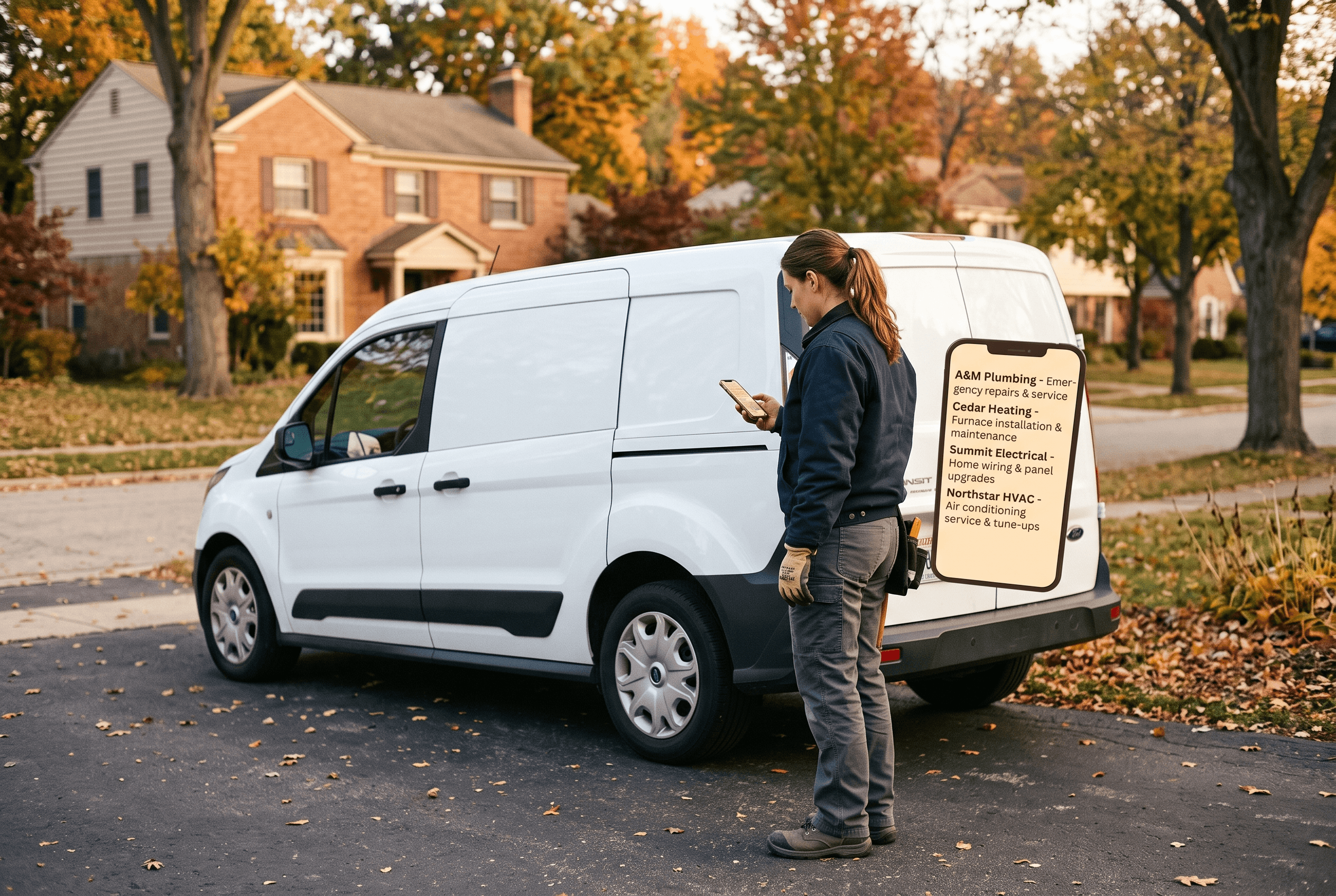
This is why the question of who AI decides to cite has become a marketing question, not just a technical one. We dug into where those citations actually come from — the Wikipedia, Reddit, and podcast sources AI leans on — and the short version is that presence is earned across the wider web, not just on your own site. It also explains why spending on getting cited in AI answers is rising faster than spending on traditional rankings, a trend we covered in GEO demand is outpacing SEO. The shortlist is the new first page, and it’s shorter.
Why does "being read" no longer mean "being visited"?
The third shift is the one that breaks the most dashboards. In the old model, if your content was useful, people visited it, and you could see the traffic. In the AI model, your content can be read, summarized, and used to inform an answer — without ever producing a visit. Forrester puts it plainly: "citation is presence, not traffic." Your page did its job. It just didn’t send you a visitor to prove it.
There’s hard data behind the feeling. A Pew Research Center analysis of the browsing behavior of 900 U.S. adults found that when a Google search returned an AI summary, users clicked a traditional result link on just 8% of those visits, compared with 15% when no AI summary appeared — and only about 1% clicked a link inside the summary itself.3 The AI summary showed up on roughly 18% of searches in that March 2025 study, and the pattern has only grown since. We walk through what this zero-click reality does and doesn’t do to a local business in are AI Overviews killing your website traffic.
The reason answer engines behave this way is structural, not accidental. Forrester puts it directly: "An answer engine exists to resolve the question, not to refer it, and once the answer lands, the sources beside it stop being interesting." A traditional search engine’s job was to send you somewhere. An answer engine’s job is to keep you from needing to go anywhere. That’s not a bug you can optimize away — it’s the product working as designed. The honest takeaway is to stop assuming that influence and traffic are the same thing. Increasingly, they aren’t.
| Traditional search era | AI answer era | |
|---|---|---|
| Where research happens | On your website and review pages | Inside a chat window, before contact |
| What the customer sees | A list of links to choose from | A short, pre-built shortlist |
| How your content pays off | A click and a visit you can measure | A citation you often can’t see |
| What "winning" looks like | Ranking on page one | Being in the answer |
If clicks disappear, how do you measure anything?
This is where a lot of owners understandably throw up their hands. If the research is invisible and the citations don’t send traffic, what’s left to manage? Forrester’s answer is a deliberate reversal of normal marketing order. Most businesses start with metrics ("what should we track?"), then decide what to publish, then maybe check what’s being said about them. He argues you should run that sequence backwards.
First, learn what AI already says about you. Open ChatGPT, Gemini, and Google’s AI Mode and ask the questions your customers ask — "best [your service] in Fort Wayne," "is [your business] reliable," "how much does [your service] cost in Allen County." Read the answers honestly. That’s your current reality, and most owners have never looked at it. Second, decide what belongs in AI answers — the accurate, consistent facts about your service area, pricing ranges, specialties, and track record that you want models to pick up. Third, and only then, pick your metrics. Forrester suggests watching your share of the questions being answered in your category and the volume of activity leaving traditional search, rather than obsessing over referral clicks that increasingly undercount your real influence.

That reordering is freeing. You don’t need a perfect attribution system to start — you need to know what the machines are telling your customers and to keep your citable facts consistent and current. Measurement comes last because, for now, it’s the least reliable piece. When you’re ready to connect AI visibility to booked customers, we laid out a practical approach in get found in AI search and track the leads — including the honest limits of what you can and can’t trace today.
What does this mean for a Fort Wayne business owner?
Let’s make it concrete. An Allen County homeowner’s furnace starts making a noise. In 2021, they’d have Googled "furnace repair Fort Wayne" and called a couple of the names at the top. In 2026, a growing share of them open ChatGPT or Google’s AI Mode and ask "who’s the best HVAC company in Fort Wayne for an older furnace" — and get back a three-name shortlist, with reasons, before they ever load a website or glance at a Google Business Profile. If your shop is one of the three, you may get a call that feels like it came from nowhere. If you’re not, you never existed in that decision.

So here’s the honest local to-do list, and it’s refreshingly un-glamorous. Audit what AI currently says about your Fort Wayne business across ChatGPT, Gemini, and Google’s AI Mode — actually run the searches. Make sure the citable facts a model would need are consistent everywhere they appear: your service area (Fort Wayne, New Haven, Huntertown, DeKalb County, wherever you actually go), your hours, your specialties, honest pricing ranges, and a steady stream of real reviews. Fix contradictions — a different address on your site than on your listing is exactly the kind of thing that makes an AI leave you out. And stop grading your marketing purely on website clicks, because a rising share of your influence now happens where no click is recorded. This is a natural fit for an AI marketing department approach, where getting found in AI search is treated as an ongoing job rather than a one-time project.
The reassuring part: none of this asks you to chase hype or buy something exotic. It raises the value of things a good local business should already be doing — being accurate, being consistent, and earning genuine trust. Get your citable facts straight and you have a real shot at the shortlist, because the model rewards clarity, not marketing budget.
How should you get started without overreacting?
Start small and start honest. Spend twenty minutes this week running your own customers’ questions through two or three AI assistants and writing down what comes back. If you’re on the shortlist, note why; if you’re not, note who is and what the model seems to trust about them. That single exercise tells you more than most paid audits. From there, the work is tightening the facts about your business everywhere they live online and building the citable, trustworthy presence that gets you included — the ongoing discipline of answer engine optimization. You don’t need to panic or rebuild everything. You need to see what your customers already see, and make sure the version of your business the machines repeat is the accurate one. If you’d rather not run that audit alone, we’re a local Fort Wayne phone call away.
Fort Wayne AI Agency service
AI Marketing Department
A full marketing department powered by AI — for less than one hire.
Learn moreFrequently Asked Questions
Are customers really deciding before they contact me?
A growing share are. Marketing strategist Duane Forrester argues that AI has shifted the buyer journey so people "arrive in the middle of a decision, not at the start of one" — researching and short-listing inside a chatbot first. Pew Research Center found about half of U.S. adults now use AI chatbots, up from roughly a third in 2024, with information-searching among the most common uses. Not every customer does this, but enough do that you cannot assume the decision starts when they reach your site.
How do I find out what AI says about my Fort Wayne business?
Open ChatGPT, Google’s Gemini, and Google’s AI Mode and ask the questions your customers ask — "best [your service] in Fort Wayne," "is [your business] trustworthy," "what does [your service] cost in Allen County." Read the answers as a skeptical customer would. This free, twenty-minute exercise shows you whether you are on the AI shortlist, who else is, and what facts the models appear to trust. Most owners have never done it, and it is the honest first step before changing anything.
If AI doesn’t send clicks, is my website still worth it?
Yes — but its job has shifted. Your site is now one of the sources AI reads to decide what to say about you, even when it does not send a visitor. Pew found that when an AI summary appears in Google results, people click a traditional link on only about 8% of visits, versus 15% without a summary. So a clear, accurate, well-structured website still matters enormously for being cited; it just cannot be judged by traffic alone anymore. Think of it as presence, not just a traffic source.
Do I need to spend a lot of money to compete in AI search?
No. The factors that help you get cited — accurate, consistent business facts, a real service area, honest pricing, and genuine reviews — reward clarity and trust more than budget. A small Fort Wayne business that gets its citable information straight across its site, listings, and review profiles can land on an AI shortlist alongside much larger competitors. The investment is mostly attention and consistency, not a big ad spend.
Should I stop tracking website clicks entirely?
Not entirely — but do not treat clicks as the whole story. Forrester recommends picking metrics last and watching broader signals like your share of the questions answered in your category and how much activity is leaving traditional search, rather than only your referral traffic. Keep your analytics, but read them knowing they now undercount the influence happening inside AI conversations you cannot see.
Sources & Further Reading
- Search Engine Journal: searchenginejournal.com/ai-changed-your-buyer-faster-than-your-business-can-adapt/591043 · AI Changed Your Buyer Faster Than Your Business Can Adapt (Duane Forrester, October 1, 2026)
- Pew Research Center: pewresearch.org/internet/2026/06/17/americans-and-ai-2026-chatbots-smart-devices-and-views-on-impact · Americans and AI 2026: Chatbots, Smart Devices and Views on Impact (June 17, 2026)
- Pew Research Center: pewresearch.org/short-reads/2025/07/22/google-users-are-less-likely-to-click-on-links-when-an-ai-summary-appears-in-the-results · Google users are less likely to click on links when an AI summary appears in the results (July 22, 2025)
Put this to work in your business
Want help with this in your business?
Tell us what you're working on — a real person in Fort Wayne replies within one business day.