How to Build Fort Wayne Local Pages AI Search Will Trust (2026)
Most Fort Wayne service businesses have one thin “Service Areas” page or a stack of near-duplicate city pages AI answer engines skip. Here’s the honest build guide.

Ask a Fort Wayne owner to show you their “local pages” and you usually get one of two things. Either a single thin “Service Areas” paragraph — a list of town names with a comma between them — or a stack of near-identical city pages where only the town name changes. Both feel like they should help you show up when an Allen County homeowner asks ChatGPT, Google’s AI Overviews, or Perplexity for a plumber or an HVAC company near them. In 2026, both quietly do the opposite.
The rules changed. A page that ranks in the Google Map Pack is not automatically a page an AI will cite by name, and the reverse is true too. AI answer engines are pickier about what they’ll trust and repeat, and they’re allergic to the template spam that used to pass for local SEO. The good news: the fixes are mostly about substance, not tricks, and a capable owner can do a lot of this without a developer. This is the honest build guide — what a trustworthy local or service-area page actually contains this year, and a worked Fort Wayne example at the end. For the bigger picture on how every local channel fits together, our Fort Wayne Digital Marketing Playbook is the reference; this piece zooms in on the pages themselves.
- AI answer engines can only recommend a page they can access, render, and parse — crawler blocking, JavaScript-only content, and stale duplicate URLs are the three most common invisible killers.
- “Swapping city names isn’t unique. Google knows.” Genuinely unique local detail is what separates a trusted page from doorway spam.
- Name your business explicitly on the page (“Company X repairs furnaces in New Haven”), and write your proof — ratings, review counts — as visible text, not a JavaScript widget an AI can’t read.
- LocalBusiness, FAQPage, and Review schema are the practical minimum, but schema only helps if it stays in sync with your visible page and your Google Business Profile.
- One experiment across 30 local queries found Perplexity cited business websites 73% of the time, while Google AI Mode leaned on Yelp (32%) and Reddit (30%) — so your own page matters most on some engines and least on others.
- Quality beats quantity: ten strong neighborhood pages beat a hundred thin ones, and thin city pages that earn no traffic should be pruned.
Why do AI search engines skip most local pages?
Before any clever content strategy, three boring prerequisites decide whether an AI can use your page at all: it has to be able to access your site, render the content, and trust the data it reads. Miss one and nothing else matters.
Access comes first. As Darren Shaw of Whitespark put it in Search Engine Journal’s roundtable on local pages for AI, “You cannot be surfaced in AI responses if the AI can’t even access your website.”1 The most common culprit is one many owners don’t know is switched on: Shaw notes that Cloudflare often blocks AI crawlers by default, a setting a previous developer may have enabled without telling anyone. Check it, and check your robots.txt while you’re there.
Rendering is the second trap. Russ Jeffery of Duda points out that ChatGPT doesn’t reliably execute JavaScript and doesn’t maintain its own web index the way Google does — so if your important content, your address, or your reviews only appear after a script runs in the browser, the AI simply never sees them. The fix is to deliver the substance through server-side rendering, not a client-side widget.
The third killer is stale data. Orphaned duplicate URLs — the old page you replaced but never removed, the ones ending in “-old,” “-new,” or “v2” — often carry an outdated phone number or address. Crawlers find them, and now conflicting information poisons what the AI repeats about you. If you’ve relaunched a site in the last few years, hunting down and redirecting those ghosts is worth an afternoon. This is the same crawlability foundation we cover in what answer engine optimization actually is — the plumbing has to work before the content can.

What does a local page an AI will trust actually contain?
Once an AI can read your page, it has to decide the page is worth citing. Two habits do most of the work here, and both run against how local pages are usually written.
First, name yourself explicitly. Shaw’s blunt framing is that “robots are kind of stupid” — they need clear subject-object relationships. So instead of “we are experts at furnace repair,” write the version that names the entity: “[Company Name] repairs furnaces in New Haven.” It reads slightly stiffer to a human, but it removes the ambiguity an AI would otherwise have to guess through. The same goes for your proof: a five-star rating loaded by a review widget is invisible to a language model. Write it in plain text — “rated 4.8 across 240 reviews” — so the claim actually exists on the page.
Second, answer the real questions customers ask. Jeffery’s suggestion is to ask the owner “what customers ask all the time” — every recurring yes-or-no question is a gap your page should fill. Shaw goes further with a research trick: use Google’s Ask Maps feature to analyze a competitor’s reviews and surface the most common pain points, then address those concerns directly on your page. That’s how you turn a generic service description into something specific enough to earn trust — and how you rank for the described need, not just the keyword.
Service-area pages vs. a page for every town
Here’s where most local page strategies go wrong. Businesses that serve an area without a storefront — HVAC, plumbing, electrical, mobile services — reach for the same shortcut: spin up one page per town, change the town name, publish twenty of them. Backlinko’s location-page guide is direct about why that fails: “swapping city names isn’t unique. Google knows.”2 And what Google flags as doorway spam, AI engines distrust too.
The alternative isn’t fewer towns served — it’s genuine local substance on the pages you do build. Backlinko’s examples are instructive: a painting company addressing the historic-preservation rules unique to one neighborhood, or an HVAC company explaining how a region’s specific climate affects system sizing. That’s detail a competitor can’t copy by find-and-replace. Encouragingly, the same guide documents service-area pages ranking on modest domains — Authority Scores in the 20-30 range — sometimes within 48 hours, because relevance and specificity can outweigh raw authority for local intent.
The scaling rule to internalize: “Ten strong neighborhood pages beat 100 weak ones.” Build pages for the markets where you actually compete, make each one genuinely useful, and prune the thin ones that generate neither traffic nor calls. Audit them quarterly. A trimmed set of strong pages will out-earn a bloated stack every time — and it won’t drag your whole site into spam territory. This is the same quality-over-quantity logic behind ranking in the Fort Wayne Google Map Pack: depth beats duplication.
What schema does a local page need in 2026?
Structured data is where owners either over-invest or skip it entirely. The honest middle: schema helps AI systems disambiguate and validate who you are — it is not a ranking lever. Shaw is candid: “I’ve never seen any noteworthy study that said, if you do schema, your traditional rankings will go up.” Its value is confirming your identity, not boosting it.
For a local page, Backlinko’s practical minimum is LocalBusiness, FAQPage, and Review markup. On the LocalBusiness side, Google’s own structured-data documentation lists name and address (as a PostalAddress) as the required properties, and recommends filling in as many others as apply: telephone, url, geo coordinates (latitude and longitude to at least five decimal places), opening hours, price range, and aggregateRating where you legitimately have one.3 Google also advises using the most specific business subtype available rather than the generic LocalBusiness type.
There’s a catch worth taking seriously. Jeffery warns that unmaintained schema becomes a third source of truth — alongside your visible website and your Google Business Profile — and when those three drift out of sync, you’ve created a “process problem,” not an optimization win. If your schema says one set of hours, your page shows another, and your Google listing a third, you’ve given the AI three answers and taught it to trust none of them. Only mark up what’s visible on the page, and keep all three in lockstep.
Which local pages actually get cited by AI?
It helps to know how differently the engines behave, because it changes where you spend effort. Backlinko ran an experiment across 30 local queries that produced 725 total citations, and the split is striking:2
| AI engine | Where it pulls local citations |
|---|---|
| Perplexity | ~73% direct business website citations |
| Google AI Mode | ~32% Yelp listings, ~30% Reddit threads |
| ChatGPT | ~22% editorial “best of” lists |
The lesson isn’t to chase one engine — it’s that your own page carries the most weight on Perplexity, while Google’s AI leans on third-party listings and community discussion, and ChatGPT loves a curated roundup. That’s a strong argument for doing both: build the trustworthy page and earn mentions on legitimate local “best of” lists, which is exactly why Google AI often names a “best of” blog instead of your shop.
Whichever engine you’re optimizing for, format for machine reading. Backlinko’s guidance is to make information scannable — pricing breakdowns, service comparisons, coverage areas — because “AI loves data it can parse quickly.” Search Engine Land’s framing of the three GEO pillars — LLM readability, brand context, and agentic commerce — points the same direction: readability isn’t a nicety, it’s the price of being quoted.4 Clear headings, short paragraphs, and honest tables do more for AI citation than any keyword density trick.
The Fort Wayne angle: a worked “HVAC Repair in New Haven” page
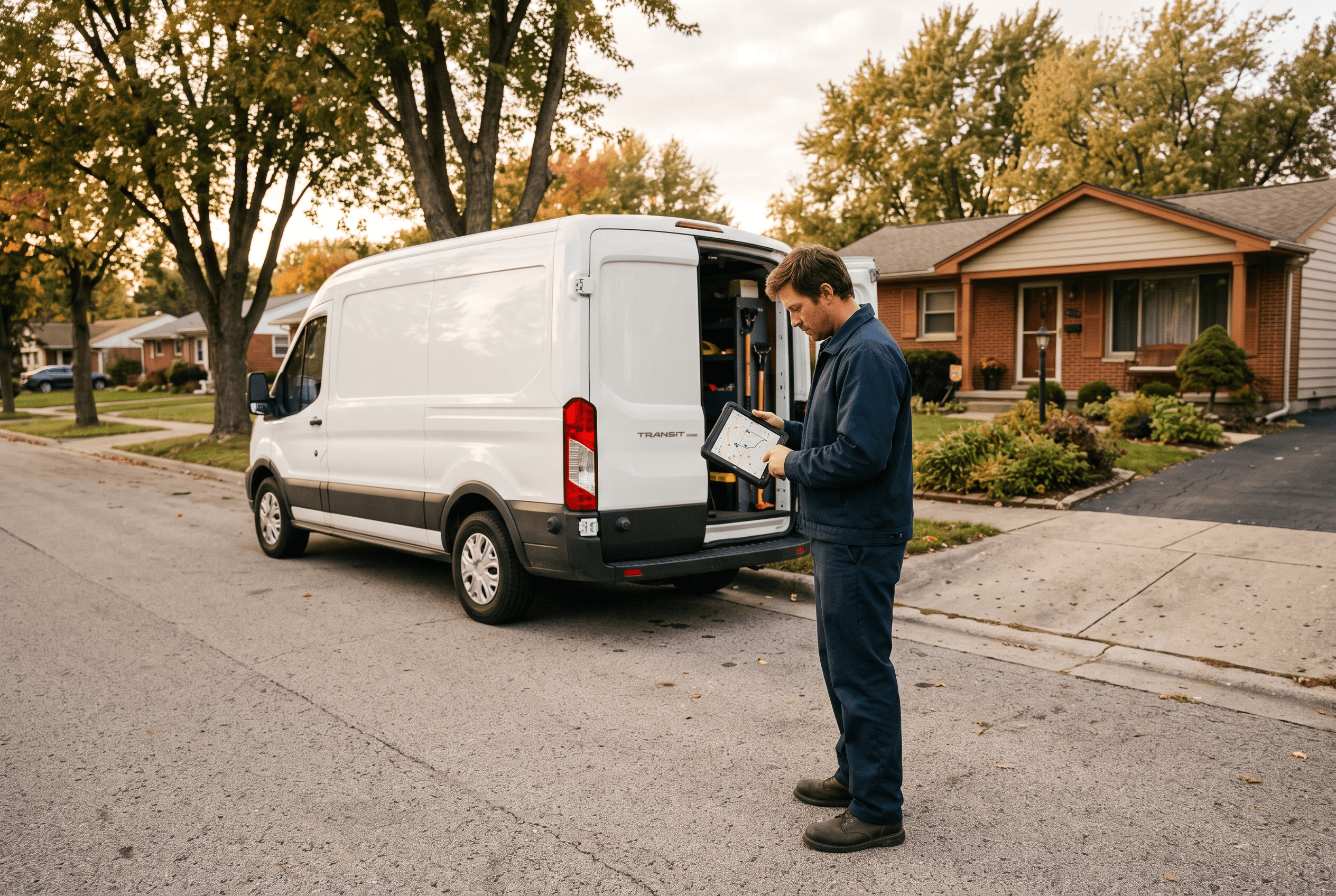
Say you run an HVAC or plumbing shop out of Auburn and you serve New Haven, Huntertown, and the rest of Allen County. The doorway-spam version is a “New Haven” page that’s your Fort Wayne page with the town name swapped. Here’s the trustworthy version instead.
Lead with the entity named plainly: “[Your Company] provides HVAC repair in New Haven, Indiana.” Then earn the page with detail nobody can copy: the age of much of the housing stock east of the river and what that means for older furnace and ductwork sizing; how a hard Northeast Indiana winter changes emergency-call patterns; a real job you did in the 46774 area, with a photo you actually took, not stock art. Add the questions New Haven callers actually ask — pulled from your own call notes — as an FAQ. Write your proof in text (“rated 4.7 across 180 Allen County reviews”), add LocalBusiness, FAQPage, and Review schema that matches, and make sure none of it hides behind a script.

One honest note from our own experience building this site: you don’t need a separate page for every town. We consolidated our service-area coverage into one strong Fort Wayne page rather than spinning up thin pages for Auburn, Angola, Garrett, Waterloo, and Butler — those all point to the Fort Wayne page rather than diluting the message across near-duplicates. Practice what we preach: quality local pages, not a page per town. If you want the measurement side — proving those pages actually turn into calls — we walk through it in getting found in AI search and tracking the leads.
If your “Service Areas” section is a comma-separated list of towns, or you’ve got a stack of city pages that all read the same, that’s fixable — and it’s exactly the work our SEO and Answer Engine Optimization services handle for Fort Wayne and Northeast Indiana businesses. We’ll confirm the crawlers can actually read you, rebuild your service-area pages with genuine local substance, get the LocalBusiness schema in sync across your site and Google Business Profile, and format everything so AI engines can quote it. If you’d rather start yourself, the checklist in this post is a real week of work that costs nothing but time. Reach out and we’ll tell you honestly what’s worth doing first.
Fort Wayne AI Agency service
SEO Services
Dominate traditional search and AI-powered answer engines.
Learn moreFrequently Asked Questions
Why doesn’t AI search show my Fort Wayne service-area page?
Usually one of three access problems: an AI crawler is blocked (often a default Cloudflare setting or a stale robots.txt rule), your content only appears after JavaScript runs so the AI never renders it, or old duplicate URLs are feeding the AI outdated contact details. Fix access and rendering first — no content strategy works until the page can actually be read.
How many location pages should a Fort Wayne business have?
Fewer, better ones. “Ten strong neighborhood pages beat 100 weak ones.” Build pages only for the areas you genuinely compete in, give each one unique local detail a competitor can’t copy, and prune thin pages that earn no traffic or calls. A page per ZIP code usually reads as doorway spam to both Google and AI engines.
What schema do I need on a local page?
LocalBusiness, FAQPage, and Review markup are the practical minimum. Google requires at least name and address on LocalBusiness and recommends adding telephone, url, geo coordinates, hours, and aggregateRating where legitimate. The critical rule: only mark up what’s visible on the page, and keep your schema, your page, and your Google Business Profile saying the same thing.
Do AI answer engines and the Google Map Pack work the same way?
No. Ranking in the Map Pack and getting cited by name in an AI answer are different games — you can win one and lose the other. AI engines assemble answers from many sources, and one experiment found Perplexity cited business websites about 73% of the time while Google’s AI Mode leaned more on Yelp and Reddit. That’s why you build a trustworthy page and pursue legitimate third-party mentions.
Can I write these pages myself, or do I need a developer?
A capable owner can do most of it: naming your business explicitly, writing proof and pain points as visible text, and adding real local detail need no code. You may want help with server-side rendering and getting the schema in sync across your site and Google Business Profile — that’s where a developer or local partner earns their keep.
Sources & Further Reading
- Search Engine Journal: searchenginejournal.com/how-to-build-local-pages-ai-systems-can-find-and-trust/588097 · How to Build Local Pages AI Systems Can Find and Trust (September 21, 2026)
- Backlinko: backlinko.com/location-pages · How to Build Location Pages That Rank, Convert, and Get Cited (September 1, 2026)
- Google Search Central: developers.google.com/search/docs/appearance/structured-data/local-business · Local Business (LocalBusiness) structured data
- Search Engine Land: searchengineland.com/geo-pillars-488782 · 3 GEO pillars: LLM readability, brand context, agentic commerce (September 16, 2026)
Put this to work in your business
Want help with this in your business?
Tell us what you're working on — a real person in Fort Wayne replies within one business day.