Is Chasing AI Search Visibility Worth It? What 2026 Data Shows
ChatGPT sends most sites under 1% of their traffic. Two respected analysts just said chasing AI visibility is overhyped. Here’s the honest read for a Fort Wayne budget.

For about a year now, the loudest advice in marketing has been some version of “get your business cited by ChatGPT or get left behind.” So it was notable that, within 24 hours of each other this week, two of the most respected independent analysts in search published essentially the same warning: the traffic AI assistants actually send is tiny, and restructuring your marketing budget to chase it is, for most businesses, a mistake. Marie Haynes put real numbers on it in Search Engine Journal, and Rand Fishkin made the budget case at SparkToro.12
This is the “we’ll tell you when you don’t need to buy something” post. If you own an HVAC company, a dental office, or a restaurant in Allen County with a few thousand dollars a month to spend, you deserve a straight answer to a simple question: is chasing AI search visibility worth it in 2026? The honest answer is mostly no — not yet, and not the way it’s being sold — but the nuance matters, so let’s walk the data before you move a single dollar. If AI is still new ground for you, our Fort Wayne small business guide to AI is the place to start; this piece is the budget-reality layer on top of it.
Key takeaways
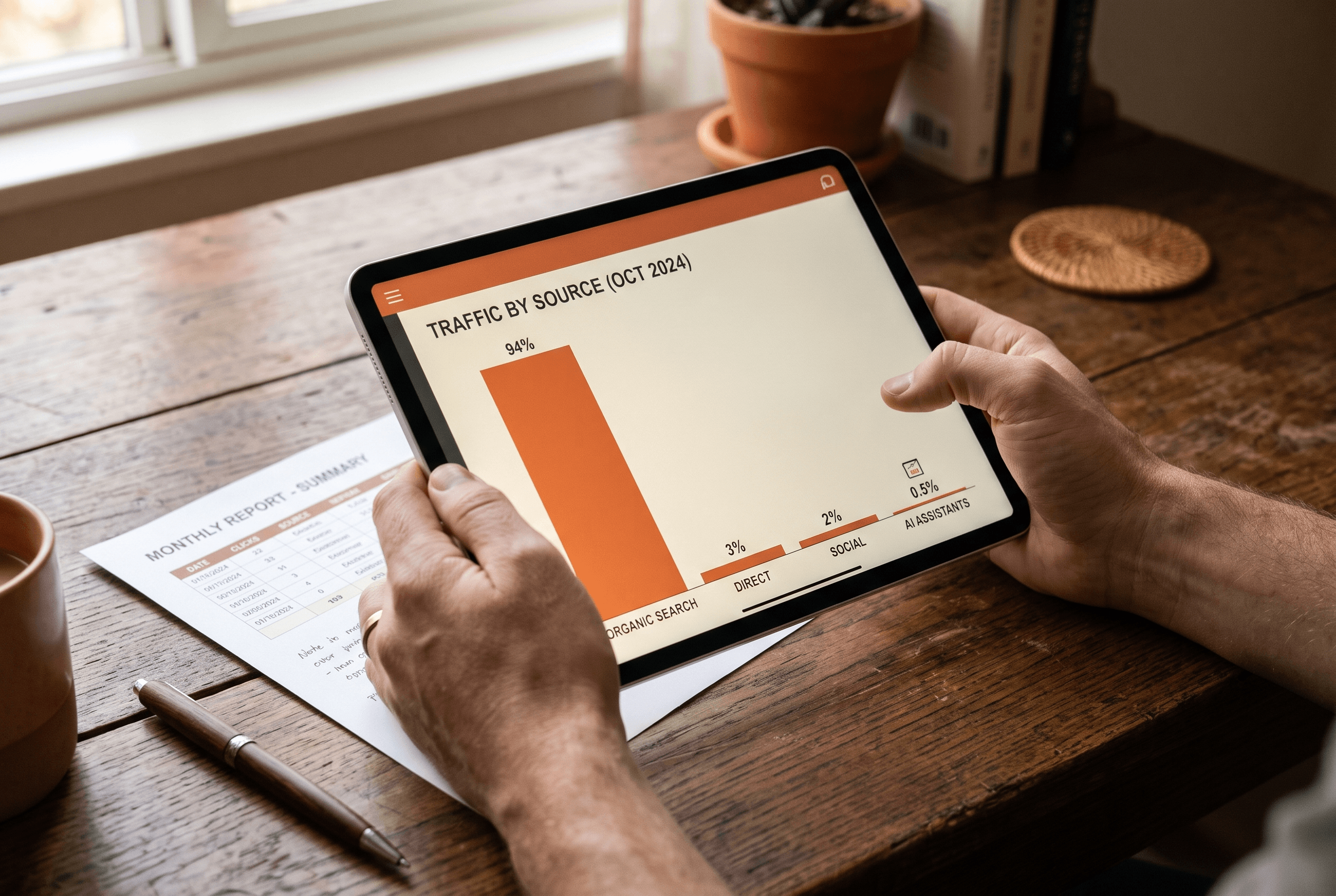
- A 100-site study found ChatGPT drove just 0.62% of Google organic traffic volume, and all AI assistants combined drove 0.73%. That’s not a typo.
- Across the same sites, Google organic drove roughly 27x more conversions than every AI assistant combined.
- AI visitors do convert at a higher rate — but on microscopic volume. High intent, tiny numbers.
- Two independent analysts (Haynes, Fishkin) landed on the same conclusion within a day: treat AI as a brand channel, not a traffic channel.
- For a budget-constrained local business, the free fundamentals — Google Business Profile, clear pricing pages, real reviews, working conversion tracking — still move the needle far more than any “AI-visibility” retainer.
- Do not hand your budget to a vendor promising ChatGPT leads. At under 1% of traffic, that’s pennies today.
How much traffic does ChatGPT actually send a small business?
Start with the number that’s doing the most damage to the hype. Haynes analyzed GA4 data from 100 randomly sampled websites — more than 145 million sessions over 12 months — and found that ChatGPT accounted for 0.62% of Google organic traffic volume. As she put it: “That’s not a typo. 0.62%.”1 Pull in every large language model together — ChatGPT, Gemini, Perplexity, Copilot, the lot — and the combined figure only rises to 0.73%. She also noted that ChatGPT’s referral growth plateaued around August 2025 and has sent fewer visitors since.
Conversions tell an even starker story. Among the 55 sites in her sample that tracked key events, Google organic drove 96.5% of all conversions — about 27 times more than every AI assistant combined.1 Haynes’ own summary of the takeaway is blunt: “chasing ChatGPT citations and LLM mentions is optimizing for the wrong target.”
She isn’t alone, and that’s what makes this worth your attention rather than dismissing it as one analyst’s hot take. The day before, Fishkin pulled together several studies pointing the same direction.2 A SEOWorks UK analysis of 95 sites (September 2025 to August 2026) found organic search delivered roughly 39 times more traffic than AI sources, and AI traffic actually converted worse than organic on 23 of the 63 sites measured. Separately, Kevin Indig’s Growth Memo tested 12 sites to see whether AI visibility quietly drives branded searches or direct visits later — the sneaky “they heard your name in an AI answer, then Googled you” effect — and couldn’t find a reliable link in his sample. Here’s how the three datasets line up:
| Study | Sample | AI traffic vs. organic | Notable finding |
|---|---|---|---|
| Marie Haynes (SEJ) | 100 sites, 145M+ sessions | ChatGPT = 0.62% of Google organic; all LLMs = 0.73% | Google drove ~27x more conversions than all LLMs combined |
| SEOWorks UK (via SparkToro) | 95 sites, 12 months | Organic ~39x more traffic than AI | AI converted worse than organic on 23 of 63 sites |
| Kevin Indig / Growth Memo (via SparkToro) | 12 sites | Not the focus | No reliable link found between AI visibility and branded/direct traffic |
Three different samples, three different methods, one consistent message: measured as a traffic channel, AI search is a rounding error for most businesses right now.
Does that mean AI visibility is worthless?
No — and this is the part the hype-merchants and the doom-mongers both get wrong, so it’s worth being precise. “Tiny as a traffic channel” is not the same as “pointless.”
Two things are true at once. First, the people AI does send tend to convert well. In Haynes’ data, ChatGPT visitors converted at 13.8% versus 3.02% for Google organic — more than 4.5 times higher.1 Ahrefs saw the same pattern in its own numbers: AI search was about 0.5% of its traffic but drove 12.1% of signups, which Ahrefs’ Patrick Stox described as “a 23x higher rate than traditional organic search visitors.”3 The visitors are high-intent — they’ve already asked the AI for a recommendation and clicked through to act. The catch, in Haynes’ words, is scale: a great conversion rate on a rounding error is still a rounding error.
Second, the smarter way to think about AI visibility is as a brand channel, not a lead firehose. Fishkin frames it as “more like a brand channel” — crediting the idea to Mike King — and calls it “a digital billboard if you will.”2 A billboard is valuable: it builds familiarity, it plants your name, it may well influence a buyer who converts through some other path later. But you don’t bill a billboard by the click, and you don’t bet your whole budget on one. When Fishkin asks whether companies should “restructure their budgets around appearing in AI tools,” his answer is “probably not” — invest in it and measure it as a brand channel, and avoid the trap of funding it like a performance channel that’s going to ring your phone.
So the honest framing is this: being present and well-represented in AI answers is worth doing. Reorganizing your marketing around it, or paying a premium for it on the promise of leads, is not — at least not on 2026’s numbers. This is also why how you measure matters so much; if you’re relying on an AI-visibility dashboard to justify the spend, read our look at whether you can trust your AI citation tracker first, because several of them miss most of what ChatGPT actually cites.
So where should a budget-constrained business actually spend in 2026?
Here’s the practical payoff, and it’s genuinely good news if your budget is tight: almost everything that makes you visible to an AI also makes you visible to a human, and most of it is free or close to it. You don’t have to choose between “optimizing for Google” and “optimizing for ChatGPT” — the fundamentals serve both. A straight do-this / measure-this / ignore-the-hype breakdown:
Do this (mostly free):
- Complete your Google Business Profile — accurate hours, service area, categories, photos, and services written out as text. This is still the backbone of local results, AI answers included.
- Write clear service and pricing pages in plain, readable text. If a human can skim your prices and service area, an AI can parse them too. The businesses that lose visibility are the ones hiding key details inside a PDF or a graphic.
- Keep earning and replying to real reviews. Review signals feed the Map Pack and the AI summaries that read from it.
- Run your own test. Type your top customer questions into Google’s AI Overviews, ChatGPT, and Gemini and see whether you’re named. It costs nothing and tells you exactly where you stand.
Measure this:
- Set up conversion tracking that actually fires. Haynes found that 45 of her 100 sites weren’t tracking any key events — meaning they literally could not tell which channel booked the job.1 You can’t allocate a budget you can’t measure. Google’s own guide to key events is a reasonable starting point, and the goal is simple: know which call, form, or booking came from where.4
- Watch the channels that actually convert — organic search, the Map Pack, your reviews, paid where it pays — and treat AI referrals as a small, high-intent bonus line, not the headline.
Ignore the hype:
- Any vendor promising a flood of “ChatGPT leads” for a monthly retainer. At under 1% of traffic, there is no flood to deliver.
- Any hard statistic claiming a specific share of search is already “AI.” The real multi-site data says otherwise.
If you want this turned into an actual priority order with real monthly budgets, that’s exactly what our Fort Wayne digital marketing playbook lays out. And it’s worth noting one honest caveat to the skeptic case: demand for AI-visibility services is genuinely rising even as the traffic stays small — a tension we unpack in GEO demand is outpacing SEO. Rising demand for a service isn’t the same as rising results from it.

What this means for a Fort Wayne business
Let’s translate the numbers for Northeast Indiana, because that’s where this stops being an industry debate and starts being your money. Picture a Fort Wayne HVAC company, a dental office off Dupont, or a restaurant downtown with $1,000 to $3,000 a month for marketing. Someone pitches an “AI-visibility optimization” package promising ChatGPT will start recommending you to Allen County homeowners. Should you buy it?
On today’s data, no. At roughly 0.6% of traffic, AI referrals for a local service business are pennies — real pennies, not a metaphor. Those same dollars do far more work pointed at the fundamentals: a complete Google Business Profile, steady reviews from actual neighbors, a transparent pricing page, and conversion tracking that shows you which channel booked the furnace repair. That’s not us talking down a service to be contrarian — the national data on Google’s own AI points the same way, and it’s the honest answer for an owner choosing between a shiny subscription and more booked jobs.
Here’s the both-and, though: get those fundamentals right and you’re already doing the work that makes AI name you, for free. The Fort Wayne businesses we work with don’t need to out-engineer Silicon Valley; they need clean listings, honest pricing, and a real reputation. When ChatGPT or Gemini does send a high-intent Allen County customer, the trick is proving it turned into a paying job — which is the whole point of connecting AI visibility to tracked local leads. Interestingly, Haynes argues the real opportunity ahead isn’t chatbot citations at all but agentic search and commerce — the shift we covered in search going agentic — and even that rewards the same clean, readable fundamentals.

Spend where it actually books jobs
If you’re staring at a marketing budget and wondering whether to carve out money for AI visibility, the most useful first move isn’t a new subscription — it’s an honest audit of what you’ve already got. We help Fort Wayne and Northeast Indiana businesses tune the signals AI engines actually read through our answer engine optimization work, and we set up the ROI reporting that shows you, in plain numbers, which channel is really booking the jobs. If the honest answer for your business is “your fundamentals are already solid, don’t spend more,” we’ll tell you that — because sometimes that’s the truth. Reach out and we’ll give you the straight read.
Fort Wayne AI Agency service
Answer Engine Optimization
Get cited inside AI answers from ChatGPT, Perplexity, and Claude.
Learn moreFrequently Asked Questions
How much traffic does ChatGPT actually send a business?
Very little, for most businesses. A 2026 study of 100 sites and over 145 million sessions found ChatGPT accounted for 0.62% of Google organic traffic volume, and all AI assistants combined reached just 0.73%. A separate 95-site UK study found organic search delivered about 39 times more traffic than AI sources. Measured as a traffic channel, AI search is a rounding error today.
If AI traffic is tiny, is AI search visibility a waste of money?
Not a waste, but widely oversold. The people AI sends tend to convert well — one study showed ChatGPT visitors converting at 13.8% versus 3.02% for Google organic — but on microscopic volume. The practical answer: being present in AI answers is worth doing, mostly through free fundamentals. Restructuring your budget around it, or paying a premium for promised AI leads, is not worth it on 2026’s numbers.
Should a small Fort Wayne business pay for an AI-visibility service?
In most cases, no. At under 1% of traffic, there aren’t enough AI referrals for a local HVAC, dental, or restaurant business to justify a monthly retainer promising ChatGPT leads. The same money does far more work on a complete Google Business Profile, real reviews, a clear pricing page, and conversion tracking — which, conveniently, is also the work that makes AI name you for free.
What should I spend my marketing budget on instead?
Lead with the free fundamentals that serve humans and AI equally: a complete Google Business Profile, service and pricing details in plain readable text, and real reviews you reply to. Then make sure conversion tracking actually fires so you can see which channel books each job — one study found nearly half of sites tracked no key events at all. Treat AI referrals as a small, high-intent bonus, not the headline.
Do AI visitors convert better than Google visitors?
Yes, by rate — but it barely matters at current scale. Haynes found ChatGPT visitors converting about 4.5x higher than Google organic, and Ahrefs reported AI visitors converting at roughly 23x its organic rate. Both point out the same catch: a strong conversion rate on well under 1% of traffic is still a tiny number of customers. High intent, very low volume.
Sources & Further Reading
- Search Engine Journal: searchenginejournal.com/geo-is-a-distraction-heres-where-the-real-opportunity-is/593870 · GEO Is A Distraction: Here’s Where The Real Opportunity Is (Marie Haynes, October 23, 2026)
- SparkToro: sparktoro.com/blog/is-ai-visibility-a-marketing-boondoggle · Is AI Visibility a Marketing Boondoggle? (Rand Fishkin, October 22, 2026)
- Ahrefs: ahrefs.com/blog/ai-search-traffic-conversions-ahrefs · Does AI Search Traffic Convert Better Than Traditional Search? For Ahrefs, Yes (Patrick Stox, June 16, 2025)
- Google: support.google.com/analytics/answer/9267568 · About key events - Analytics Help
Put this to work in your business
Want help with this in your business?
Tell us what you're working on — a real person in Fort Wayne replies within one business day.