Should You Let Meta’s AI Run Your Fort Wayne Facebook Ads?
Meta wants to run your whole Facebook and Instagram ad campaign with AI — you hand it a URL and a budget. When should a Fort Wayne business say yes, and where do you keep a human?
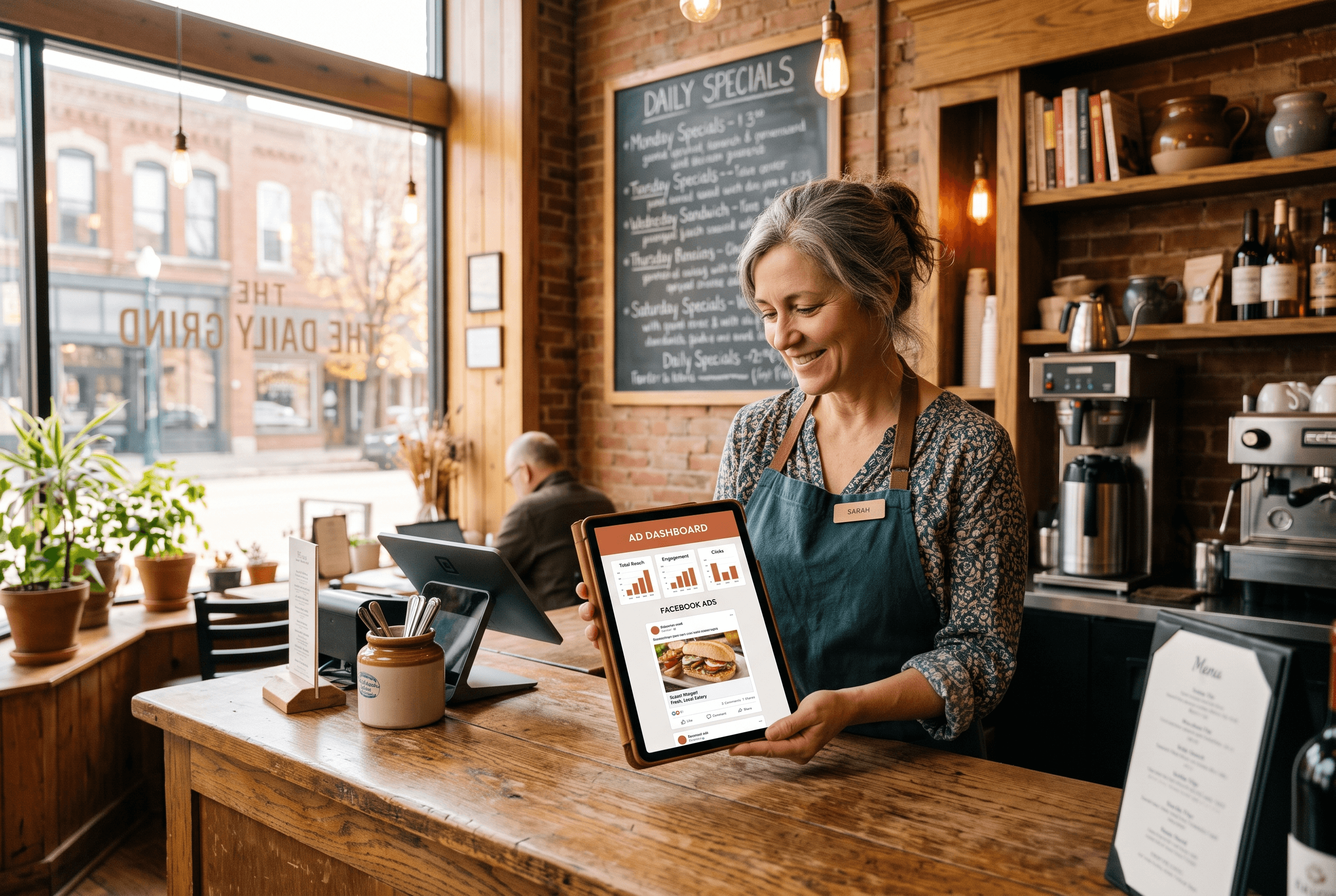
Meta has been clear about where it wants to take advertising: you tell it your goal, connect a bank account, and its AI handles the rest — the copy, the image or video, and who sees it. For a Fort Wayne restaurant owner or an HVAC company juggling a hundred other jobs, that sounds like a relief. Hand over a website URL and an $800-a-month budget, and let the machine figure out Facebook and Instagram.
The honest question isn’t *can* it do this — Meta says it’s building exactly that. The question is whether you *should* let it run the whole thing for a local business, and where handing off the wheel quietly costs you more than it saves. This is the plain-English version we’d give a client who doesn’t want to torch a month’s ad budget finding out.

- Meta is moving toward fully AI-run ad campaigns: you supply a URL and a budget, and its AI generates the creative and picks the audience.
- Advantage+ automation has been the default for new Meta campaigns since late 2025 — so parts of this are already live, not future tense.
- AI is genuinely good at the math-heavy parts: bidding, budget pacing, and finding audiences at scale.
- The real risks for a local shop are generic "everyone’s ad looks the same" creative, brand erosion, and thin data on small budgets.
- The headline performance figures you’ll see quoted are Meta’s own self-reported numbers, not independently verified, and came from big advertisers with far more data than a $1,000-a-month local account.
- Our recommendation: automate the optimization, keep a human on brand and creative, and test with a ring-fenced budget before you commit.
What Is Meta Actually Building?
Meta’s stated direction is a campaign that needs almost nothing from you. As Marketing Dive reported on the company’s plans, a brand could hand Meta an image of what it wants to promote plus a budget goal, and the AI would create the entire ad — imagery, video, and text — then decide who sees it on Facebook and Instagram.1 Mark Zuckerberg framed it bluntly in an interview the outlet cited: “you come to us, you tell us what your objective is, you connect to your bank account, you don’t need any creative, you don’t need any targeting demographic.”1
That’s the destination Meta describes for 2026. But this isn’t purely a someday story. Advantage+ — Meta’s automated campaign suite — became the *default* setup for new campaigns in Meta’s Ads Manager back in late 2025, according to SocialBee’s running log of Meta ad changes, and through 2026 the company added AI photo and video editing tools and expanded its AI business assistant to advertisers.3 In other words, the automation is arriving in layers, and the default settings already lean toward “let the AI decide.”
If you want the wider context on how paid channels fit together for a local business, our Fort Wayne Digital Marketing Playbook ranks where paid social sits against search, reviews, and the rest — worth reading before you pour budget into any single channel.
Can Meta’s AI Really Run My Whole Campaign Today?
Partly, yes — and more of it every quarter. Today you can launch an Advantage+ campaign, let Meta expand your audience automatically, and have it optimize placements and bids across Facebook, Instagram, and their feeds. What’s still maturing is the “you don’t even need creative” piece: AI-generated and AI-edited ad images and video are rolling out, but handing over *all* creative judgment is the part Meta is still building toward rather than a finished, hands-off product.
Adoption is already wide. Forbes reported that about 65% of advertisers now run their campaigns through the Advantage+ suite.2 So the practical question for a Fort Wayne owner isn’t whether to touch AI ads at all — you likely already are, by default — but how much control to keep.
Should a Fort Wayne Small Business Let It?
Our answer is a split decision, and it matches the framework in the Forbes analysis: automate the optimization, keep a human on the brand. AI is legitimately better than most of us at the mechanical work — bid management, budget pacing, and testing dozens of audience combinations faster than any media buyer. That’s math, and machines win at math.
What AI does *not* understand is your business. It doesn’t know that your HVAC company has answered emergency calls in Allen County for 30 years, or that your restaurant’s whole appeal is the family behind the counter. Forbes put the tension well: performance metrics are not the same as brand identity. Here’s how we’d divide the work:
| Hand to Meta’s AI | Keep a human on |
|---|---|
| Bidding and budget pacing | Brand voice and messaging |
| Audience testing and expansion | The core offer and promise |
| Placement selection (feed, Reels, Stories) | Photos and video that show the real business |
| Day-to-day optimization | Deciding what a “good” lead actually is |
If you’re weighing whether to run this yourself, hire in-house, or bring in help, our breakdown of an AI marketing department vs. an in-house hire vs. an agency walks through the real Fort Wayne costs of each path.
What Could Go Wrong for a Local Shop?
This is where the honest guidance earns its keep. Four risks matter most for a small local advertiser:
- The race to the middle. When every competitor runs the same automated software with the same AI-written copy, ads start to look identical. Forbes calls it the moment “your ads begin to appear identical” — and for a local business whose edge *is* being different, that’s a quiet loss.
- Brand erosion. AI-generated messaging can drift from your tone and values. On a national brand that’s a rounding error; on a Fort Wayne business where trust is the whole product, off-brand creative can undo years of goodwill with a customer base that knows you by name.
- The small-budget data problem. Meta’s automation learns from data, and it learns best on large budgets. Forbes notes the gains were driven by big advertisers with substantial datasets; on a $1,000-a-month local account, the AI has thin data to learn from, and the “learning phase” can quietly eat your spend.
- Lead quality. AI optimizes for whatever target you give it — usually cheap conversions. That can mean it finds one-time buyers rather than repeat customers, dropping your cost-per-lead while also dropping the *value* of each lead. This is exactly why we tell owners to watch lead quality, not just cost-per-lead.
A word on the numbers floating around: you’ll see eye-catching percentages — big drops in cost, specific return-on-ad-spend claims. Treat them carefully. The performance figures Meta highlights are its own self-reported numbers, not independently verified, and they usually measure something like “cost per incremental conversion” rather than the cost-per-lead a local shop actually tracks. They also come from advertisers far larger than a local shop, with the data volume that makes the automation shine. Meta’s honest public position is directional — it says Advantage+ “performs better” than manual setups. We won’t hand you a percentage to expect on an $800-a-month Fort Wayne campaign.
What Does It Cost to Test Meta AI Ads Safely?
You don’t have to choose between “all in” and “ignore it.” Test it the way you’d trial any new tool — with a fence around the budget and a human checking the output. A safe structure looks like this:
- Ring-fence a test budget you can afford to learn from — often a few hundred dollars a month, separate from your proven campaigns.
- Approve the creative before it runs. Let Meta generate options, but don’t let anything off-brand go live. Real photos of your team and your work almost always beat AI-generated stock.
- Set one clear goal — real phone calls or form fills, not vague “engagement.”
- **Watch lead *quality*, not just cost.** Ask your front desk whether the leads are turning into customers, or just tire-kickers.
- Run it beside your existing ads for 30 days before you shift real budget over.
If you’re setting a monthly number, our Fort Wayne Google Ads benchmarks by industry give realistic cost ranges you can use as a sanity check, and our guide to whether Google Ads are still worth it covers how to tell if paid ads are paying off at all before you add another channel. To judge results honestly, track the seven marketing metrics that actually matter — cost-per-lead and lead quality both live on that list.
The Fort Wayne Angle
Picture a Northeast Indiana pizza shop and an Auburn HVAC company both handing Meta a URL and a budget. The pizza shop might do fine on automation — the offer is simple, the audience is broad, and a slightly generic ad still sells a Friday-night special. The HVAC company is a different story: its leads are worth hundreds of dollars each, its reputation was built one honest service call at a time, and a flood of cheap, low-intent clicks would waste both money and the technician’s time chasing bad leads.
That’s the real Fort Wayne lesson. The right amount of AI depends on how much each lead is worth and how much your brand carries the sale. A low-ticket, high-volume local business can lean into automation sooner. A high-trust, high-value service business should automate the plumbing and keep a firm human hand on the message — because in a market this connected, word travels, and one off-brand campaign is felt.
Getting Help With Meta Ads in Fort Wayne
If you’d rather not run the experiment blind, that’s what we’re here for. Our advertising management work sets up Meta and Google campaigns with the automation dialed to the right level for your budget — and a human keeping the creative on-brand and the leads worth having. When paid social ties into your organic presence, our social media marketing team keeps the two working together instead of at cross-purposes. We’ll also tell you honestly if a few hundred dollars is better spent somewhere other than Meta this quarter. Reach out and we’ll map a safe test to your actual numbers.
Fort Wayne AI Agency service
Advertising
Targeted paid campaigns across Google, Meta, and more.
Learn moreFrequently Asked Questions
Can Meta’s AI really run my entire ad campaign?
It’s getting close. Meta’s stated goal is that you provide a URL and a budget and its AI generates the creative and chooses the audience. Today, its Advantage+ automation already handles bidding, budget pacing, audience expansion, and placement by default; fully AI-generated creative is still rolling out rather than finished. So you can automate most of a campaign now — but "hands completely off" isn’t quite here yet.
Should a small business let Meta’s AI control everything?
We recommend a hybrid: automate the optimization (bidding, budgets, audience testing) and keep a human on brand, creative, and the definition of a good lead. AI is excellent at the math-heavy work but doesn’t understand your reputation or tone, which for a local business is often the whole sale.
Will AI ads lower my costs?
Maybe, but be careful with the numbers. Meta reports its automated campaigns perform better than manual ones and points to its own performance figures — but those are self-reported, not independently verified, and came from large advertisers with far more data than a small local budget. On a modest budget the AI has thin data to learn from, so treat any promised savings as unproven until you’ve tested it yourself.
How much should I budget to test Meta AI ads?
Ring-fence an amount you can afford to learn from — often a few hundred dollars a month — kept separate from campaigns that already work. Approve the creative before it runs, set one clear goal like phone calls, and run the test for about 30 days while watching lead quality, not just cost-per-lead.
What’s the biggest risk for a Fort Wayne business?
Generic, off-brand creative. When every competitor runs the same automation, ads start to look identical, and AI-written copy can drift from the voice your customers trust. For a business whose edge is being local and different, that sameness — plus a possible flood of low-quality leads — is the real cost to watch.
Sources & Further Reading
- Marketing Dive: marketingdive.com/news/meta-plans-to-enable-fully-ai-automated-ads-by-2026/749613 · Meta plans to enable fully AI-automated ads by 2026 (June 17, 2025)
- Forbes: forbes.com/sites/terdawn-deboe/2026/04/25/meta-will-run-your-entire-ad-campaign-with-ai-should-you-let-it · Meta Will Run Your Entire Ad Campaign With AI. Should You Let It? (April 25, 2026)
- SocialBee: socialbee.com/blog/facebook-updates · Facebook & Instagram Updates (2025–2026 tracker) (June 30, 2026)
Put this to work in your business
Want help with this in your business?
Tell us what you're working on — a real person in Fort Wayne replies within one business day.
Keep reading
Marketing & Advertising
The Fort Wayne Digital Marketing Playbook: How Local Businesses Grow in 2026
AI & Automation
AI Marketing Department vs. In-House Hire vs. Traditional Agency: A Fort Wayne Cost Comparison
Marketing & Advertising
The Only 7 Marketing Metrics a Fort Wayne Business Owner Needs to Track