Use Claude to Run a Conversion Audit on Your Fort Wayne Website (Free Checklist)
You can use an AI assistant to find the conversion leaks on your Fort Wayne website — if you know its limits. Here is the honest checklist and what a human still has to decide.

Your Fort Wayne website gets visitors. The phone still does not ring enough. Somewhere between the click and the booked job, people are leaking out — and finding *where* usually means paying for a conversion-rate-optimization (CRO) audit you may not have budget for.
Here is a middle path that is genuinely useful in 2026: you can use an AI assistant like Claude to do the early, tedious parts of a conversion audit yourself — sorting your analytics, spotting the obvious friction, and drafting a prioritized list of fixes. What you *cannot* do is let it decide what is true. That is the honest boundary, and getting it right is the difference between a helpful head start and a confidently-wrong to-do list.
This post gives you a free checklist you can hand to an AI assistant, plus a clear line down the middle of what the AI does well and what a human — you, or someone you trust — still has to validate.
What can Claude actually do in a conversion audit?
The useful, well-documented answer comes from a workflow published on the DEV Community and echoed in Search Engine Land’s guide on running a stronger CRO audit with Claude.1 The short version: an AI assistant is a triage tool, not a decision-maker.3
Concretely, the DEV workflow has you build an "evidence pack" — separating your performance data, your page observations, and your business context — and then let the AI do three jobs: review the analytics and return structured fields (page, sessions, conversions, period-over-period changes, possible explanations, next steps); turn raw observations into testable findings; and organize everything into a reviewable brief. Its own summary of the payoff is modest and honest: "faster movement from raw material to a reviewable working brief." That is it. It saves you the sorting and formatting, not the thinking.
For a Fort Wayne service business, that is still real time saved. If you have never used an AI assistant for business work, our Small Business Guide to AI is the right starting point — this is exactly the kind of bounded, high-value task where AI earns its keep, in the same spirit as teaching it your office busywork.
The free 8-point checklist you can hand to an AI
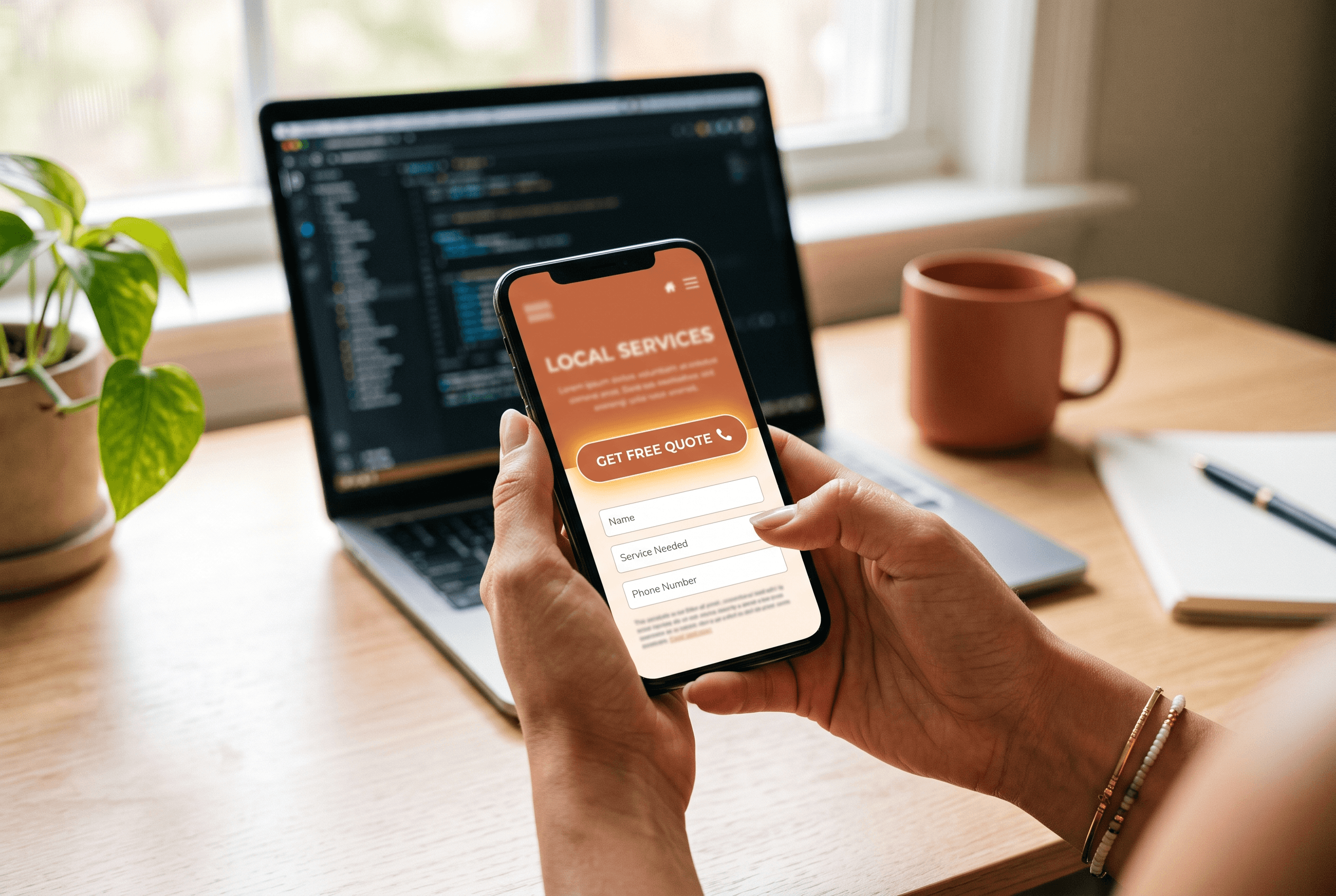
The Ryze landing-page CRO auditor checks eight factors, and they make a clean checklist you can paste into any capable AI assistant along with your page.2 Point it at your homepage or a key landing page and ask it to evaluate each:
- Headline — Is there a clear value proposition in under ten words? Does it match the ad or search that brought people there?
- Subheadline — Does it expand on the headline with a specific benefit?
- Hero CTA — Is your main call-to-action visible above the fold without scrolling?
- Social proof — Are testimonials, reviews, logos, or case studies visible?
- Form — Are you asking only for the minimum fields? Is the submit button text clear?
- Trust signals — Are guarantees, a privacy note, or credentials near the form?
- Page speed — Does the page load within about three seconds?
- Mobile — Is everything fully functional and tappable on a phone?
The Ryze tool also flags common "conversion killers": competing CTAs, escape-hatch navigation that pulls people away, vague button text, and missing trust elements. For a local service site, that mobile-and-CTA combination is usually where the money leaks — most Allen County customers are searching on their phones. If you want real numbers to compare against, our post on why your Fort Wayne website isn’t getting calls has the 2026 conversion benchmarks for local service businesses.
What must a human still decide?

This is the part that keeps an AI audit from backfiring. The DEV workflow is blunt about the limit: "Claude cannot determine whether the source data is trustworthy, complete, or interpreted correctly for the business." And its sharpest line is one every owner should tape to the monitor — "A faster shortlist is not the same as a validated explanation for why a page is underperforming."
So the human keeps four jobs:
- Judge the data. Is that traffic drop real, or did a tracking tag break? Is it a seasonal Fort Wayne slowdown, not a page problem?
- Supply business context. The AI does not know your margins, your best customers, or that half your leads come from a referral partner.
- Decide what to test. Every AI suggestion is a hypothesis. You pick which ones are worth the effort.
- Confirm the pattern is meaningful — not a reporting error or a one-week fluke.
Notice too what the eight-point checklist quietly leaves out: whether your copy is actually persuasive, whether the design fits your audience, the judgment calls that need a person. The AI is fast at the mechanical layer and silent on the human one.
Why "clean data first" matters more than the AI

An AI audit inherits every flaw in your analytics. If your site counts a conversion every time someone visits the contact page — instead of when they actually call or submit a form — the AI will confidently analyze a number that means nothing, and hand you a tidy, wrong report. Garbage in, structured garbage out.
That is why the real first step is not the AI at all — it is honest conversion tracking. The good news is this got easier in 2026: Google folded no-code conversion tracking into Tag Manager, so a Fort Wayne owner can now define "a booked call" or "a form submission" as a conversion without a developer for most cases. Get that right, *then* let the AI triage it. Do it in the other order and you are just automating a mistake faster.
What this means for a Fort Wayne business
For a local HVAC company, dental office, restaurant, or contractor, the practical play is this: spend an afternoon running your top two pages through the eight-point checklist with an AI assistant, fix the obvious leaks it surfaces (a buried phone number, a bloated seven-field form, a slow mobile load), and treat everything else as a list of experiments to run over the next quarter. That alone will out-perform doing nothing while you wait for budget for a full paid audit.
Where it stops being a DIY job: when the leaks are not obvious, when the fixes need real development, or when you would rather have someone validate the data and run proper tests. An AI can also *become* part of the fix — an AI chatbot that catches after-hours questions is one common conversion patch — but that is a decision to make with eyes open, not a default.
Want the audit done right — with a human checking the AI?
Running the checklist yourself is a great start, and we would rather you try it than pay for something you do not need. But when the leaks are hidden or the fixes need real work, our conversion optimization team validates the data, runs the tests properly, and implements the changes — using AI tools to move faster while a human stays responsible for what is actually true. Either way, you will know where your Fort Wayne website is losing customers.
Fort Wayne AI Agency service
Conversion Optimization
Turn more visitors into paying customers.
Learn moreFrequently Asked Questions
Can Claude or ChatGPT really audit my website for conversions?
To a useful point, yes. An AI assistant can triage your analytics, evaluate a page against a CRO checklist, and draft a prioritized list of likely conversion problems. What it cannot do is confirm your data is accurate or guarantee that a change will improve results — those judgments stay with a person.
Is an AI CRO audit as good as hiring a professional?
No, but it is a strong free head start. AI is fast at the mechanical first pass — sorting data and spotting obvious friction. A professional adds validated testing, business context, real development, and accountability for the outcome. Use AI to find the obvious leaks, and bring in help when the fixes get complex.
What's the biggest risk of using AI for a conversion audit?
Trusting bad data. An AI will faithfully analyze whatever numbers you feed it, so if your conversion tracking is broken or misconfigured, you will get a confident report built on a false foundation. Verify your tracking counts real calls and form submissions before you run the audit.
What should I check first on my Fort Wayne website?
Start with mobile and your main call-to-action, since most local customers search on their phones. Make sure your phone number and primary button are visible without scrolling, your contact form asks only for essential fields, and the page loads in about three seconds. Those are the most common leaks for local service sites.
Do I need to know how to code to run an AI conversion audit?
No. You can paste the eight-point checklist and your page details into a capable AI assistant and read the results in plain English. You will need trustworthy conversion tracking first, which Google's no-code tools now make possible for most small businesses without a developer.
Sources & Further Reading
- DEV Community: dev.to/alifar/claude-cro-audit-workflow-faster-data-triage-with-human-evidence-validation-3jfk · Claude CRO Audit Workflow: Faster Data Triage With Human Evidence Validation (2026)
- Ryze: get-ryze.ai/claude-openclaw-clawdbot-skills/cro-landing-page-audit · Landing Page Conversion Auditor — CRO Skill (2026)
- Search Engine Land: searchengineland.com/how-to-use-claude-to-run-a-stronger-cro-audit-487726 · How to use Claude to run a stronger CRO audit (September 10, 2026)
Put this to work in your business
Want help with this in your business?
Tell us what you're working on — a real person in Fort Wayne replies within one business day.