Local AI Search: 5 Fort Wayne Fixes Google Wants (2026)
Google’s local team says AI is turning simple “near me” searches into specific, conversational requests. Here are 5 fixes a single Fort Wayne business should make to stay the answer.

For years, showing up in local search meant getting the basics right: claim your Google listing, keep your hours accurate, collect a few reviews, and you’d land in the Map Pack when someone nearby searched for what you sell. That playbook still matters — but it’s no longer the whole game. On a September 24 webinar recapped by Search Engine Journal, Google’s Caroline Dissaux, joined by Uberall’s Krystal Taing and Adecco’s Bonnie White, laid out where local AI search is heading — and it changes what a listing has to do.1
The short version: AI is turning broad local searches into specific, conversational requests. “HVAC repair near me” is becoming something closer to “who can fix a heat pump on the north side tonight and takes Visa.” A name-and-hours listing can’t answer that. The good news is that Google’s team also outlined how to get ready, and most of it is work a single Fort Wayne shop can do without an enterprise budget. Below, we’ve translated their five strategy fixes — framed for big multi-location brands on the webinar — down to one owner in Allen County. This is the operational readiness checklist behind the broader Fort Wayne digital marketing playbook, not a rehash of it.
Key Takeaways
- Google says local AI search is shifting from broad keywords to specific, conversational questions — so your listing needs to answer real questions, not just state your name and hours.
- Fix 1: build one source of truth. Audit your hours, categories, attributes, and services so AI never reads two different versions of your business.
- Fix 2: close the review gap. Reviews are where AI learns what you’re actually good at — and where it picks up the facts you never wrote down.
- Fix 3: localize your content for real. Genuine Fort Wayne and Allen County detail beats templated copy that AI treats as filler.
- Fix 4: automate the busywork, but keep a human on anything brand- or policy-sensitive.
- Fix 5: measure at the location level — track what customers ask AI about your business and what it answers back.
What Is Google Actually Saying About Local AI Search?
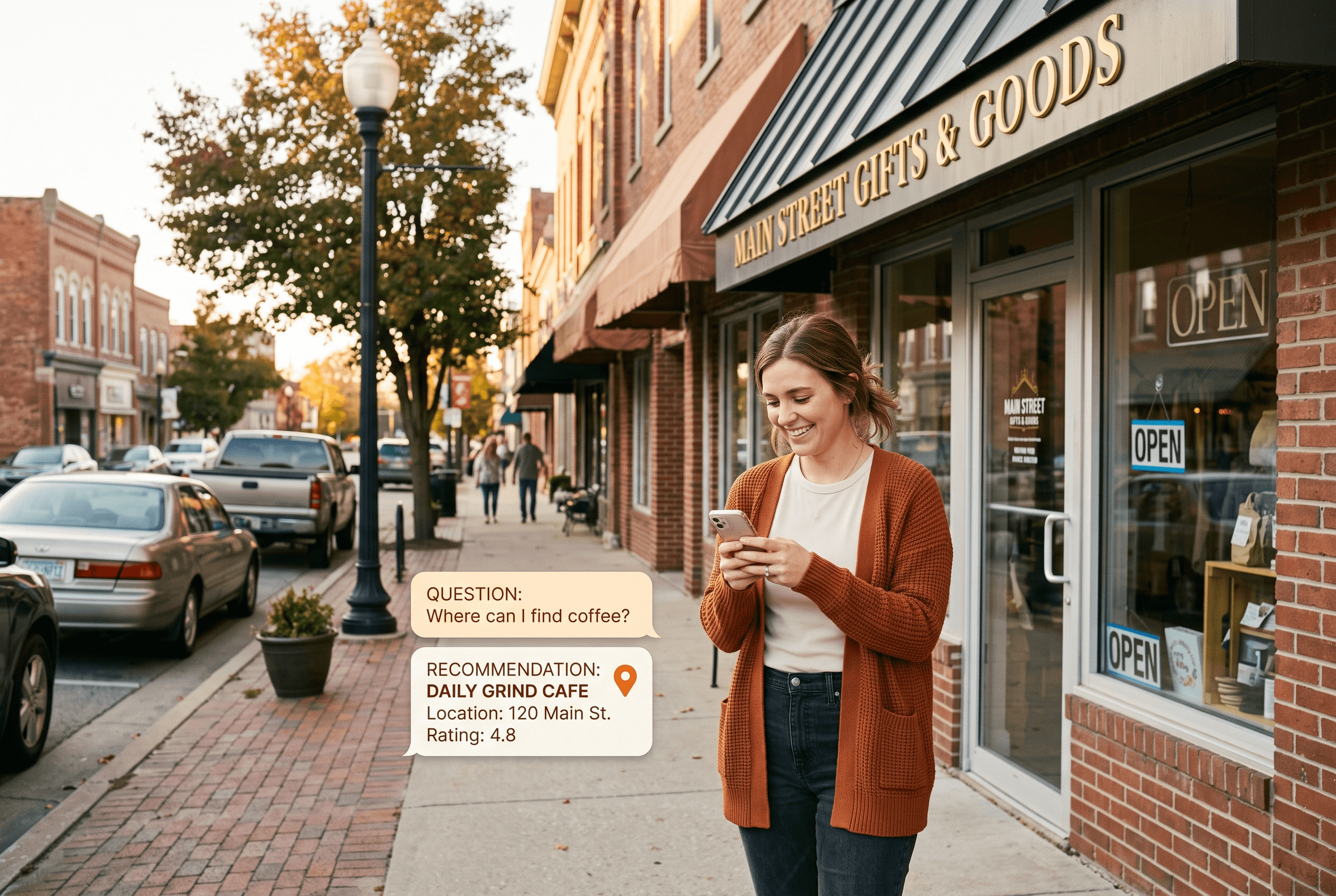
The headline from the webinar isn’t a new feature — it’s a shift in behavior. Google’s Dissaux described local queries moving from broad terms to specific requests: customers now ask whether a particular business offers a specific service, at a specific time, with the amenities they need. That’s a much richer question than “plumber Fort Wayne,” and it demands a much richer listing to answer.
The data backs up why this matters now. According to BrightLocal’s Local Consumer Review Survey 2026, 45% of consumers used AI tools for local business recommendations — up from just 6% a year earlier. The same survey of 1,002 U.S. adults found that 97% of AI users at least sometimes double-check an AI recommendation against real reviews.2 So AI isn’t replacing the fundamentals; it’s sitting on top of them. If your listing, your site, and your reviews disagree with each other, AI has no clean answer to give — and it may hand the customer to a competitor who’s easier to read.
As Uberall’s Krystal Taing put it on the webinar, “Most of us really have been talking about these things for years. What’s different is the scale, the complexity, and importance.” In other words, the tactics below aren’t exotic. They’re the local-SEO basics, raised in stakes because a machine is now doing the reading. Here’s the prioritized fix list.

Fix 1: Do You Have One Source of Truth for Your Business Info?
The first fix is the least glamorous and the most important: audit every place your business facts live and make them agree. Google’s team framed this as building “one source of truth” — a single, correct version of your hours, categories, attributes, services, and booking details that everything else matches. For a Fort Wayne shop, that usually means your Google Business Profile, your website, and any directory listings all telling the identical story.
Two fields do the heaviest lifting. Your primary category tells Google what you fundamentally are, and picking the wrong one quietly keeps you out of the right results — a problem we dig into in why your competitor outranks you on Google Maps. The second is attributes — the yes/no details like “wheelchair accessible,” “free parking,” or accepted payment types. Google lets you add these directly in your profile (Google’s help page walks through where), and they’re exactly the specifics an AI request like “takes Visa and open late” now filters on.4
On your own website, the machine-readable version of this is LocalBusiness structured data. Google Search Central’s documentation spells out the properties worth including — name, address, telephone, opening hours, and geo coordinates — so an AI system reading your site gets the same facts your listing shows.3 In our experience, this single alignment pass fixes more “why doesn’t AI find me” problems than any clever tactic.
Fix 2: Are You Closing the Review Gap — or Just Collecting Stars?
The second fix reframes reviews. Most owners treat them as a scoreboard — get the star average up, respond to the angry ones. Google’s team pushed a different use: reviews are a source of information AI reads to learn what you actually do, and they surface the facts you forgot to publish. If three customers mention you did same-day water-heater work, that’s a service detail AI can now cite — even if it isn’t on your site yet.
“Closing the review gap” means two habits. First, a real response protocol so no review sits unanswered — the discipline we lay out in the Fort Wayne online reviews and reputation guide. Second, mining your reviews for the questions and details customers keep raising, then feeding those back into your listing and site. If reviewers keep asking whether you service Auburn or DeKalb County, that’s a gap to fill in your service area and copy.
This matters more because of how AI users behave. Remember that 97% of them cross-check AI answers against real reviews. A strong, current review profile isn’t just a ranking factor anymore — it’s the trust layer customers use to confirm whatever AI told them about you. Thin or stale reviews break that loop.

Fix 3: Is Your Content Actually Local, or Just Templated?
The third fix is about content that reads as genuinely local instead of mass-produced. Google’s team described localizing “at scale” — reusing approved offers while adding accurate neighborhood and service detail — but a single-location Fort Wayne business gets the easy version of that problem: you only have one place to describe, so describe it honestly and specifically.
That means real detail: the neighborhoods you serve, the local landmarks near your shop, the services you actually offer in Allen County versus the ones you don’t. Generic copy — “we’re the area’s trusted provider of quality service” — gives AI nothing to work with and reads like filler. If you run separate location or service-area pages, they need to earn their place; we cover how to build Fort Wayne local pages AI search will trust rather than stacking near-duplicate city pages that answer engines skip.
The honest caveat: “localize” is not an excuse to spin up dozens of thin pages stuffed with town names. That’s the pattern Google’s spam systems are built to catch. The goal is fewer pages with more real, verifiable local substance — the kind a neighbor would recognize as true.
Fix 4: Where Should You Automate — and Where Should a Human Stay?
The fourth fix is about using tools without handing them the keys. Google’s team endorsed automation for the tedious parts — systems that flag missing fields, outdated hours, or unanswered questions — while insisting a human review anything brand- or policy-sensitive. Taing was direct about the line: “It doesn’t mean that a human needs to manually review every single thing,” she said, but “humans should be the ones establishing the strategy.”
For a small Fort Wayne business, that’s freeing rather than daunting. You don’t need enterprise software. You need a simple loop: let a tool (or a checklist, or an AI assistant) catch that your holiday hours are wrong or a new service isn’t listed, and keep yourself in the seat for the judgment calls — how you word a sensitive review reply, whether a promotion is accurate, what you promise about pricing. Automate the flagging; own the deciding.
Where owners get burned is skipping the human half — letting a tool auto-publish AI-written descriptions or auto-reply to reviews without a read. That’s how a factual error or an off-brand tone reaches a customer. If you’re weighing which tasks are safe to hand off first, that’s a core piece of what a modern answer engine optimization engagement sorts out.
Fix 5: Can You Measure What AI Says About Your Business?
The last fix is measurement — and it’s the one most owners have no system for yet. Google’s team recommended tracking at the location level: what questions are customers asking, and what is AI answering about your specific business? For a single-location shop, “location level” just means your business, but the discipline is the same: you can’t fix what an AI gets wrong about you if you never check.
Practically, that starts with the free tools. Google Search Console now reports how often your pages appear in AI Overviews and AI Mode — we walk through what it shows and what it can’t in tracking your AI search visibility in Fort Wayne. Beyond that, do the manual check: periodically ask ChatGPT, Gemini, and Google’s AI the questions a real customer would — “best HVAC repair in Fort Wayne,” “who does emergency plumbing in Allen County” — and note whether you appear and whether the details are right.
Tie it to outcomes, not vanity. The number that matters isn’t “did AI mention me” — it’s whether visibility turned into a call, a booking, or a filled-out form. Measuring that connection is exactly the gap between looking busy and getting paid.
What Local AI Search Looks Like for a Fort Wayne Business
Strip away the enterprise framing and here’s the ground-level version for a shop in Fort Wayne, Auburn, or DeKalb County. You don’t have a hundred locations to reconcile — you have one, which means the whole checklist is a weekend of focused work, not a software rollout. Spend an hour making your Google Business Profile, website, and directory listings agree. Spend another closing the loop on reviews. Rewrite the one “areas we serve” section on your site so it names the neighborhoods you actually cover. Set a monthly reminder to ask the AI tools what they say about you.
The businesses that stay visible as local search goes conversational won’t be the ones with the biggest budgets — they’ll be the ones whose facts are clean, whose reviews are current, and whose content is genuinely local. That’s the same foundation good local SEO and SEO work has always rested on; AI just raised the price of getting it wrong. If any of the five fixes reads like “we’ve been meaning to do that,” that’s your starting point.
Ready to Get Found in Fort Wayne’s AI Search?
If you’d rather not spend that weekend auditing listings and structured data yourself, that’s the work we do. We’ll align your business info into one source of truth, tighten your review and content foundation, and set up the measurement so you can actually see what AI says about your Fort Wayne business — then tell you honestly which fixes will move the needle and which can wait. Tell us what you’re trying to fix and we’ll give you a straight answer, not a sales pitch. No obligation, and if a couple of free tools would do the job, we’ll say so.
Fort Wayne AI Agency service
Answer Engine Optimization
Get cited inside AI answers from ChatGPT, Perplexity, and Claude.
Learn moreFrequently Asked Questions
What is local AI search, and how is it different from regular local SEO?
Local AI search is when tools like ChatGPT, Gemini, and Google’s AI Overviews answer a customer’s local question directly — recommending a business — instead of just listing links. It builds on regular local SEO rather than replacing it: the same accurate listing, reviews, and content that help you rank still feed the AI. The difference is that AI reads for specific, conversational details, so vague or conflicting information hurts you more than it used to.
Do I need to do anything different if I’m a single-location Fort Wayne business?
Yes, but it’s simpler for you than for a big chain. The five fixes Google outlined were framed for multi-location brands, but a single Fort Wayne shop gets the easier version — one set of hours, one service area, one story to keep consistent. The core work is making your Google Business Profile, website, and any directory listings agree, keeping reviews current, and writing genuinely local content.
How many people actually use AI to find local businesses?
According to BrightLocal’s Local Consumer Review Survey 2026, 45% of consumers used AI tools for local business recommendations, up from about 6% a year earlier. Notably, 97% of those AI users said they at least sometimes double-check the AI’s recommendation against real reviews — so a strong review profile still matters even when a customer starts with AI.
Should I automate my Google Business Profile updates?
Automate the detection, not the deciding. Tools that flag outdated hours, missing services, or unanswered reviews save real time. But per the guidance from Google’s webinar, keep a human on anything brand- or policy-sensitive — sensitive review replies, pricing claims, promotions — before it publishes. Auto-publishing AI-written content without a read is where small businesses get burned.
How do I know if AI is recommending my Fort Wayne business?
Start with Google Search Console, which now reports how often your pages show in AI Overviews and AI Mode. Then do a manual check: ask ChatGPT, Gemini, and Google’s AI the questions a real customer would — like “best HVAC repair in Fort Wayne” — and see whether you appear and whether the details are accurate. Tie it to real outcomes like calls and bookings, not just whether your name came up.
Sources & Further Reading
- Search Engine Journal: searchenginejournal.com/google-on-whats-next-in-ai-search-5-local-marketing-strategy-fixes/590978 · Google On What’s Next In AI Search + 5 Local Marketing Strategy Fixes (September 29, 2026)
- BrightLocal: brightlocal.com/research/lcrs-ai-trust · Local Consumer Review Survey 2026: AI and Business Recommendations (September 1, 2026)
- Google Search Central: developers.google.com/search/docs/appearance/structured-data/local-business · Local Business (LocalBusiness) structured data
- Google Business Profile Help: support.google.com/business/answer/9049526 · Manage your business attributes
Put this to work in your business
Want help with this in your business?
Tell us what you're working on — a real person in Fort Wayne replies within one business day.